




Web社内報はどれくらい読まれているもの?
「Web社内報は、他社さんではどれくらい読まれているものですか?」
こうした相談を、お客様からよく寄せられます。
では、実際はどれくらいの閲覧率なのでしょうか。
産業編集センターでは、クライアント企業※を対象に、定期的に「インターナルコミュニケーションに関する調査」を実施しており、その中に「紙の社内報・Web社内報の閲読状況」という設問を設けています。
(※調査期間:2022年11月〜2023年1月、回答社数:155社)
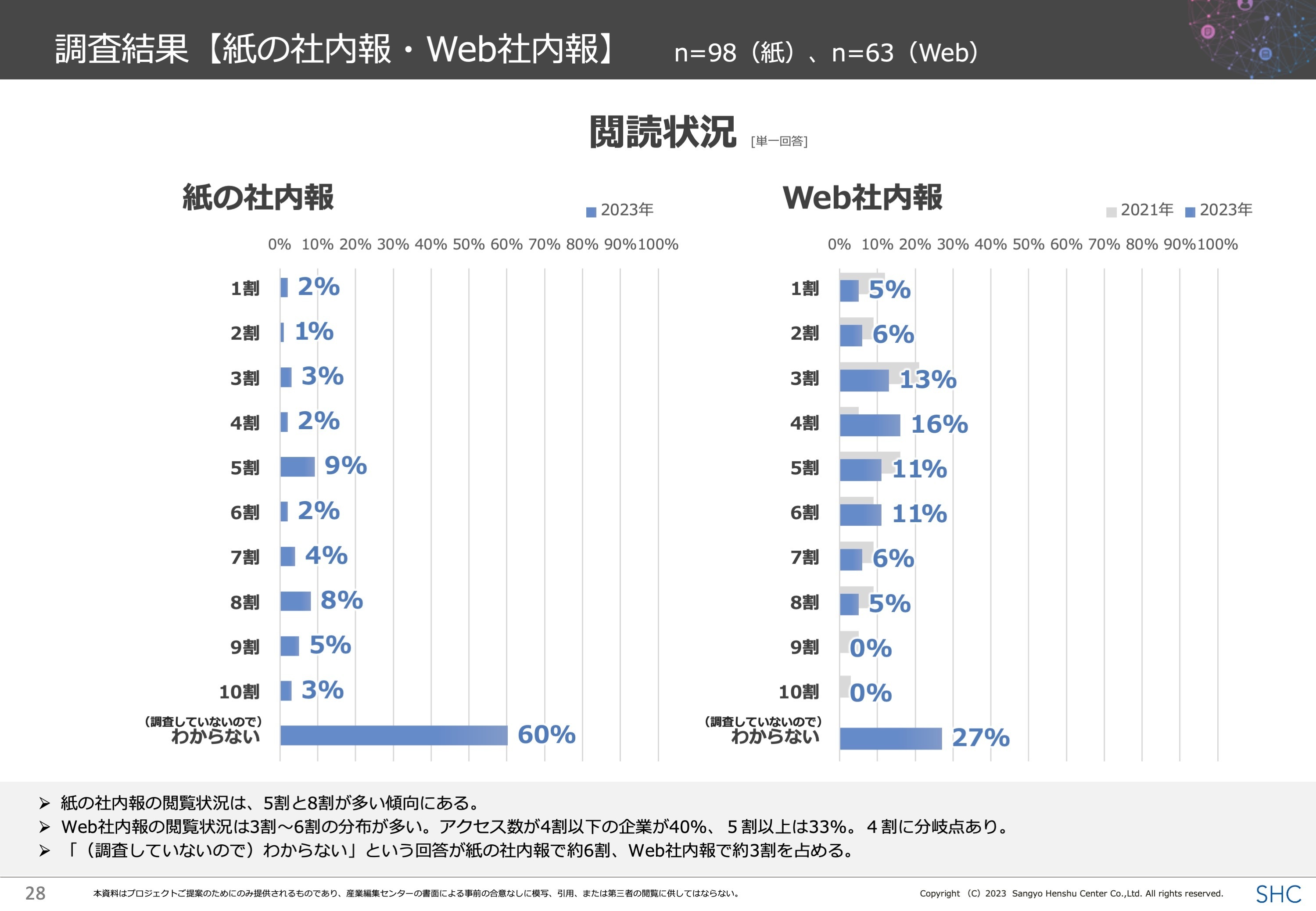
この回答結果から明らかになったのは、Web社内報の閲覧率のボリュームゾーンは「4割」ということ、また「5割以上」と回答した企業は約3分の1に留まっているということです。
Web社内報の閲覧率には「4割の壁」があることが分かります。
“How widely are online company newsletters actually read at other companies?”
This is a question we often hear from our customers.
So, what are the real readership rates? Let’s take a look at the data.
At Sangyo Henshu Center, we regularly conduct surveys* on internal communications for our client companies. One of the key questions focuses on readership levels for both printed and online company newsletters.
(*Survey period: November 2022 to January 2023; number of companies surveyed: 155)
The results revealed that online newsletters typically have a readership rate around 40%, and only about one-third of companies report a readership of 50% or more.
This indicates there’s a 40% “ceiling” that’s hard to break through.
では、Web社内報の閲覧率は、どんな要因に左右されるのでしょうか。
ひとつは、閲覧環境です。
「1人1台、PC・スマートフォン等の個人端末を持っているか」「普段からスマートフォンを業務で使用しているか」、つまり日常業務の中に、Web社内報にアクセスしやすい動線があるかが、閲覧率を大きく左右すると考えられます。
So, what factors influence online newsletter readership?
One key factor is the viewing environment.
Do all employees have personal devices like PCs or smartphones? Do they regularly use smartphones as part of their daily work? In other words, whether employees have easy, routine access to the online newsletter can greatly affect readership.
Web社内報は「コンテンツマーケティング」発想へ
そして、もうひとつは「Web社内報のあり方」です。
Web社内報のあり方は、ここ数年で大きく変化しています。
【Web社内報1.0】
かつては紙をデジタル化することが最大の目的でした。単に紙をPDFにして配布したり、ページをHTMLで構築するなど、極めてシンプルな構造を持っていました。そこでは、印刷されないだけで、おおよそ紙と同じような運用がされていました。
【Web社内報2.0】
Web2.0への進化とともにWeb社内報も大きく変化します。いわゆるCMSによる構築が主軸となり、随時かつ即時に記事を発信するようになっていきます。UI/UXも向上し、「いいね」「コメント」「スマートフォンでも閲覧できる(レスポンシブ対応など)」といった機能を有するWeb社内報が増えていきました。その頃は「メイン媒体は、紙の社内報」「即時性の高いニュース発信は、Web社内報」というすみ分けが主流でした。しかし、このすみ分けでは、Web社内報の閲覧率が伸び悩む企業が多かったのも事実です。
【Web社内報3.0】
そして、Web社内報は、コロナ禍以降、さらなる進化を遂げます。個人認証と連動させた「パーソナライズ機能」の実装や、読者のペルソナを細かく定義しそれぞれに最適なコンテンツを届ける、よりコンテンツマーケティング的な発想を取り入れたWeb社内報へと変化しています。実際、そうした発想や技術を取り入れて作られたWeb社内報は、以前と比較して、より多くの読者を獲得することができています。
こうしたトレンドが影響して、産業編集センターが実施する「インターナルコミュニケーションに関する調査」においても、Web社内報の閲覧率の平均値は上がってきています。
Another important factor is the role that the newsletter plays within the company. This role has changed drastically over the past few years.
[Online Company Newsletters 1.0]
In the past, the main goal was to digitize paper. Content was distributed as PDFs or presented on basic HTML pages, resulting in very simple page layouts. While the format was digital, the newsletters were managed much the same way as their paper counterparts.
[Online Company Newsletters 2.0]
With the rise of Web 2.0, online company newsletters evolved significantly. CMS-based platforms became standard, allowing articles to be published continuously and updated in real time. UI and UX improved, and many newsletters added features such as likes, comments, and mobile-friendly responsive design. During this period, roles were often divided, with printed newsletters positioned as the primary medium and online newsletters used mainly for time-sensitive updates. In practice, however, this split made it difficult for many companies to increase readership of their online newsletters.
[Online Company Newsletters 3.0]
Since the COVID-19 pandemic, online internal newsletters have continued to evolve. They are increasingly incorporating content marketing-driven approaches, such as personalization features linked to individual user authentication and the delivery of tailored content based on carefully defined reader personas. In practice, newsletters built around these ideas and technologies have been able to attract more readers than in the past.
Reflecting these trends, surveys on internal communication conducted by the Sangyo Henshu Center also show a rise in the average readership rate of online internal newsletters.
閲覧率“4割の壁”を突破した企業も
実際、産業編集センターがご支援している大阪ガス様も、「Web社内報3.0」発想の媒体にリニューアルし、“4割の壁”を突破しています。
自社のインサイトを深め、動線や機能、コンテンツをしっかりと設計することが、より活発なコミュニケーションが生まれるWeb社内報を実現する手がかりになるでしょう。
Osaka Gas is one example of an SHC customer that has updated their online newsletter to version 3.0, ultimately breaking through the 40% ceiling.
By gaining deeper insights into your company and thoughtfully designing access routes, features, and content, you can create online newsletters that foster more engaging and active communication.